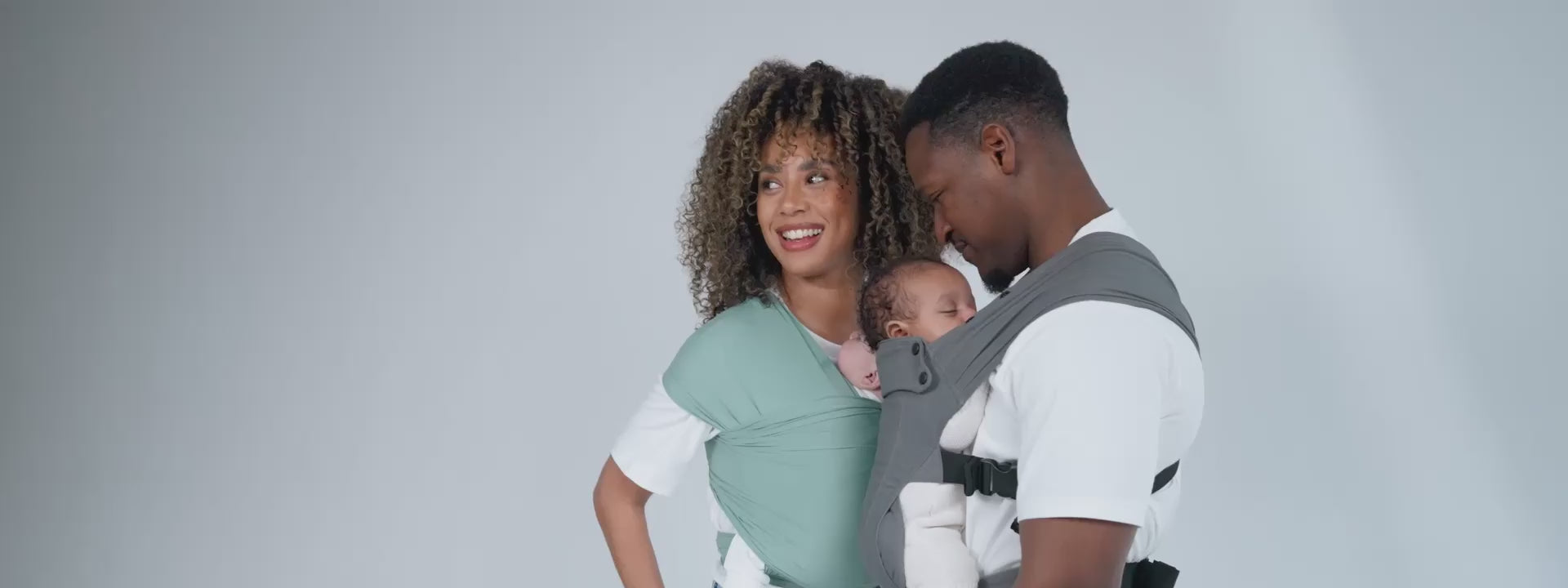
One of the things I’ve learned after many years working in babywearing is this: carrying doesn't suddenly stop when children start walking. In fact, for many families, that’s when it becomes most useful.
I’ve worked with thousands of parents over the years through sling libraries, consultations, training, and our work at Izmi. One pattern comes up again and again: “Our child has outgrown our baby carrier… but we still really need to carry them. And we don’t always want to take a buggy just-in-case.”
Sometimes that child is 2 years old. Sometimes 4. Sometimes 6.
And very often those families are supporting a child with additional needs, a disability, or a neurodivergent profile. These are children who might get tired more quickly, struggle with sensory overwhelm, or simply need more physical support than the average toddler. For many families, carrying remains a really important part of everyday life long after the baby stage has passed.
That is exactly why Emily and I designed the Izmi Adventure Carrier and the Izmi Breeze Adventure Carrier. These are lightweight, supportive carriers built specifically for older babies, toddlers and big kids, typically from around 1 year old to 6 years old. With a generous 32kg weight limit - that’s the highest weight limit of any child carrier on the market.
We designed the Izmi Adventure "Toddler" (and more!) carrier, because real life does not follow the neat timelines that baby product marketing often assumes.
Importantly, it packs down tiny and weighs just 680g; it fits easily into even small bags, so you can always have it with you - just in case. Made from soft, natural cotton, it’s super comfy to wear - it’s pretty much an instant hug in a bag :)

Why many families still need to carry older children
There’s a very common assumption that once children can walk, carrying is finished. Anyone who has spent much time with toddlers knows that’s not really how childhood works!
Children walk until they get tired. They walk until something becomes overwhelming. Until you meet a big crowd, or have to walk up a big hill. They walk until they suddenly need comfort or reassurance.
For some families this happens occasionally. For others it happens every day.
In the UK it is estimated that around 1 in 20 children have some form of disability, and a significant proportion of those children struggle with walking long distances. Some experience fatigue. Some have pain or reduced stamina. Others have conditions affecting coordination, balance or muscle tone.
Over the years I’ve supported families carrying children with many different diagnoses and health conditions. These include Down syndrome, hypermobility, global developmental delay, life limiting illnesses and a wide range of chronic health conditions. For many of those families, having a comfortable toddler carrier that works for bigger kids genuinely changes what everyday life looks like. It allows them to go further, stay out longer, and do ordinary family things without constantly worrying about whether their child will manage the distance.
Sometimes carrying is about mobility. Sometimes it’s about comfort. Often it’s both.
If you’re interested in hearing a very honest and personal story from one of the families we’ve supported, I’d really recommend reading Carrying Through a Diagnosis: Rachel and Hero’s Story. It beautifully captures how carrying can support families navigating complex health journeys.

A carrier designed specifically for bigger kids
Most baby carriers are really designed for babies, even if they claim to work for toddlers. Lots of big name carriers claim to last until 3 or 4 years - but they’re really over promising. Parents often discover that once their child gets past two or three years old, those carriers simply aren’t comfortable anymore. Shoulders start to ache, backs start to protest, and the carrier itself no longer feels supportive enough.
When we designed the Izmi Adventure Toddler Carrier, our goal was very simple. We wanted to create something that genuinely works for bigger children while still being lightweight and practical for parents.
That meant designing a carrier that distributes weight well, supports growing bodies comfortably, and still folds down small enough that parents will actually take it with them. The Adventure Carrier supports children from around 9kg up to 32kg, which typically covers toddlers and preschoolers up to around six years old. It’s particularly popular for 1-4 year olds; but from experience, it can also be great for very tall 6 or 7 month olds, up to very petite 10 year olds.
Importantly, it doesn’t feel like hiking equipment. It packs down small enough to fit in a backpack or changing bag and weighs just 680g! That matters more than people realise, because most parents do not want to carry their child all day. They simply want the option when they need it.
And when a child suddenly needs carrying, the most important thing is having that option with you.
Why the Adventure Carrier works so well for neurodivergent kids
Another group of families who often find toddler carriers incredibly helpful are families with neurodivergent children.
Both Emily and I have neurodivergent children in our own families, so this is something we care deeply about on a personal level as well as professionally. Many children with autism, ADHD or sensory processing differences benefit enormously from close physical contact with a trusted adult.
Being carried can provide deep pressure, a sense of safety and a predictable physical connection that helps regulate the nervous system. For some children it helps them stay calm in busy environments. For others it becomes a way to reconnect during moments of sensory overload or emotional dysregulation.
Raquel from Carry Ollie Slings shared something that will sound familiar to many parents:
“I do use it (the Izmi Adventure Carrier) with my 5 year old with ADHD. It is such a lovely way of reconnecting when he is struggling with big feelings.”
If you’d like to explore this topic more deeply, we’ve written about it in much more detail here:
Why many families of neurodivergent kids choose to carry for longer.
It’s something we see again and again with the families we support.

Real families using the Adventure Carrier

One of the best parts of working in babywearing is seeing how families adapt carriers to their own lives. The ways people use them are often incredibly creative.
Siobhan from Coventry Sling Library shared how the Izmi Adventure Carrier helped on a camping trip with her family:
“Using the Adventure Carrier on holiday this August helped us with our youngest who has hypermobility. We couldn't fit his wheels in with all our camping gear, so a sling it was! Loved how even for a preschool carrier it folded down small. It fitted myself and my husband beautifully despite being two different body shapes. B found it super comfy as well and because it folded down small we were able to pop it in our rucksack 'just in case.'"
That 'just in case' factor comes up again and again when parents talk about toddler carriers. You might not need it for the whole day, but when your child suddenly needs carrying, you’re very glad you brought it.
Supporting families with disabled children
Over the years I’ve supported many families carrying children with a wide range of disabilities and health concerns. Some children fatigue quickly or experience pain when walking long distances. Others have lower muscle tone or joint instability that makes walking difficult or exhausting. For some families, mobility equipment is part of everyday life, but there are still plenty of situations where carrying simply works better.
Parents often tell me they use their carrier for things like school runs, hospital visits, busy environments, holidays or anywhere with uneven ground and stairs. In those moments, a carrier can sometimes be far simpler than a buggy or wheelchair.

A lovely mum I met called Cristina shared how helpful her Izmi carrier has been while travelling with her 4 year old daughter, Emilia, who has Down Syndrome:
“The carrier has been lovely, particularly when we travel. On our trip to Portugal we didn’t get Emilia’s pushchair back until baggage reclaim, so having a comfortable way to carry her made a huge difference. When we’re out of our routine or on holiday, Emilia often needs that extra closeness to help her regulate and settle, and the carrier works beautifully.”
Something people are often surprised by is that carriers can frequently work alongside medical equipment. I’ve worked with families carrying children who have feeding tubes, orthotics or hip harnesses, and in many cases a well-fitted carrier can accommodate those needs surprisingly well.
Of course every child is different, and sometimes it’s helpful to talk things through. If you’re wondering whether an Izmi carrier might work for your child, please do get in touch with us. We’re always happy to chat through individual situations and help families figure out what might work best.
Adventure Carrier vs Breeze Adventure Carrier
People often ask what the difference is between the Izmi Adventure Carrier and the Izmi Breeze Adventure Carrier.
The simple answer is the fabric.

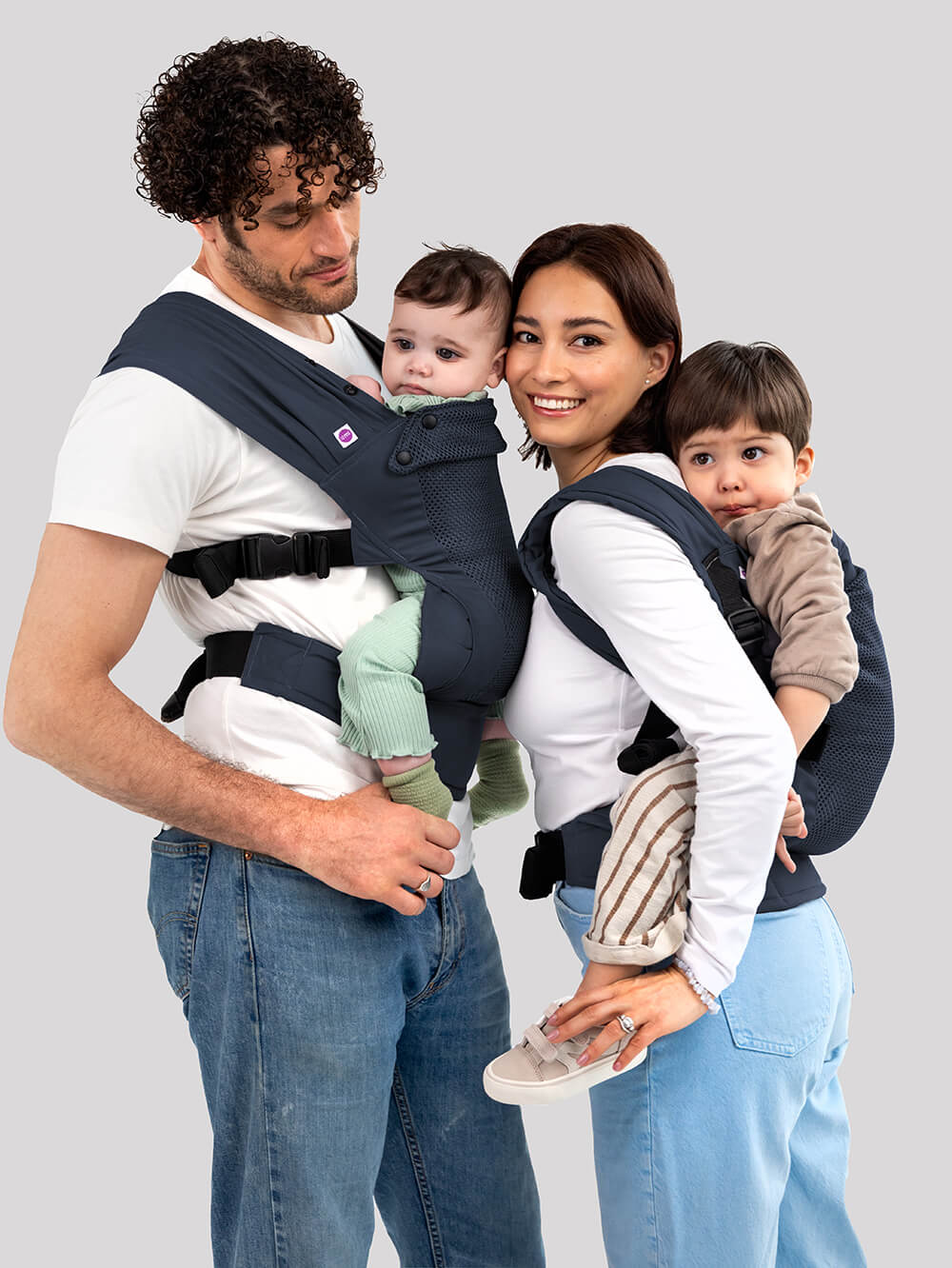
Izmi Adventure Carrier and Izmi Breeze Adventure Carrier
Both come in a choice of colours and can be worn in an H-strap (rucksack style) position, or X-strap crossed position.
The Adventure Carrier is made from soft cotton. The Breeze Adventure Carrier includes a breathable mesh panel that increases airflow and keeps things cooler, which many families find particularly helpful in warm weather or when carrying energetic bigger kids.
Structurally though, they are the same supportive carrier. Both are designed to carry children from around 9kg up to 32kg, with front, back and hip carry options and a design that packs down small enough to fit easily into a bag.
Try an Izmi Carrier before you buy
One of the things we are particularly proud of at Izmi is how connected we are with the babywearing community across the UK.
There are over 130 sling libraries and babywearing consultants around the UK where you can try or hire Izmi carriers before buying. If you’d like to find somewhere local, you can explore the list here:
Where to Try Izmi Carriers
Trying a carrier in person can be especially helpful when carrying bigger children, because fit and positioning matter even more as children get heavier.
That’s also why we offer free one-to-one fit checks with every Izmi carrier. Getting the fit right can make a huge difference to comfort for both parent and child, particularly when carrying older children. Our team is always happy to help parents adjust their carrier properly so that it works as comfortably as possible.
When little legs get tired
Many parents discover toddler carriers when they suddenly realise their child can walk, but cannot necessarily walk everywhere.
You might find yourself searching for things like a carrier for a disabled child, a toddler carrier for a four-year-old, a carrier for an autistic child, or a big kid carrier for a five-year-old.
If that sounds familiar, you are absolutely not alone.
Carrying does not stop when children start walking. For many families it simply evolves as children grow.
And sometimes having the right carrier makes all the difference.
If you’d like to chat about whether the Izmi Adventure Carrier or Breeze Adventure Carrier might work for your family, please do get in touch. We’re always happy to help parents think through what might work best.
Because sometimes the simplest solution is still the best one.
When little legs get tired, it helps to know you’ve got another option.